
Rules
Nonprofit email journeys: advocacy and fundraising
An overview of nonprofit email journeys for advocacy and fundraising, with segmentation, political disclaimers, donor disclosures, and a worked sequence.
What to take away
- Nonprofit email journeys can involve two regimes: Federal Election Commission rules for anything that supports a candidate or party, and Internal Revenue Service rules for charitable solicitation.
- Political email disclaimer rules require specific wording on public communications, and the FEC's reporting calendar drives when your subscriber data must be reconciled.
- IRS disclosure and substantiation rules govern the receipt you promise donors, so your fundraising journeys need to capture the right information at the point of giving.
- A single subscriber can be both a donor and an advocacy contact, so your segmentation and consent records have to serve both sets of rules.
- Enforcement usually starts with a complaint or an audit, not a random sweep, so documentation of what you sent and to whom is your best protection.
FEC rules for advocacy and campaign email
Email programs may include issue advocacy, candidate support and charitable appeals. A nonprofit can therefore send messages with different purposes to overlapping audiences, so each journey needs clear segmentation and review.
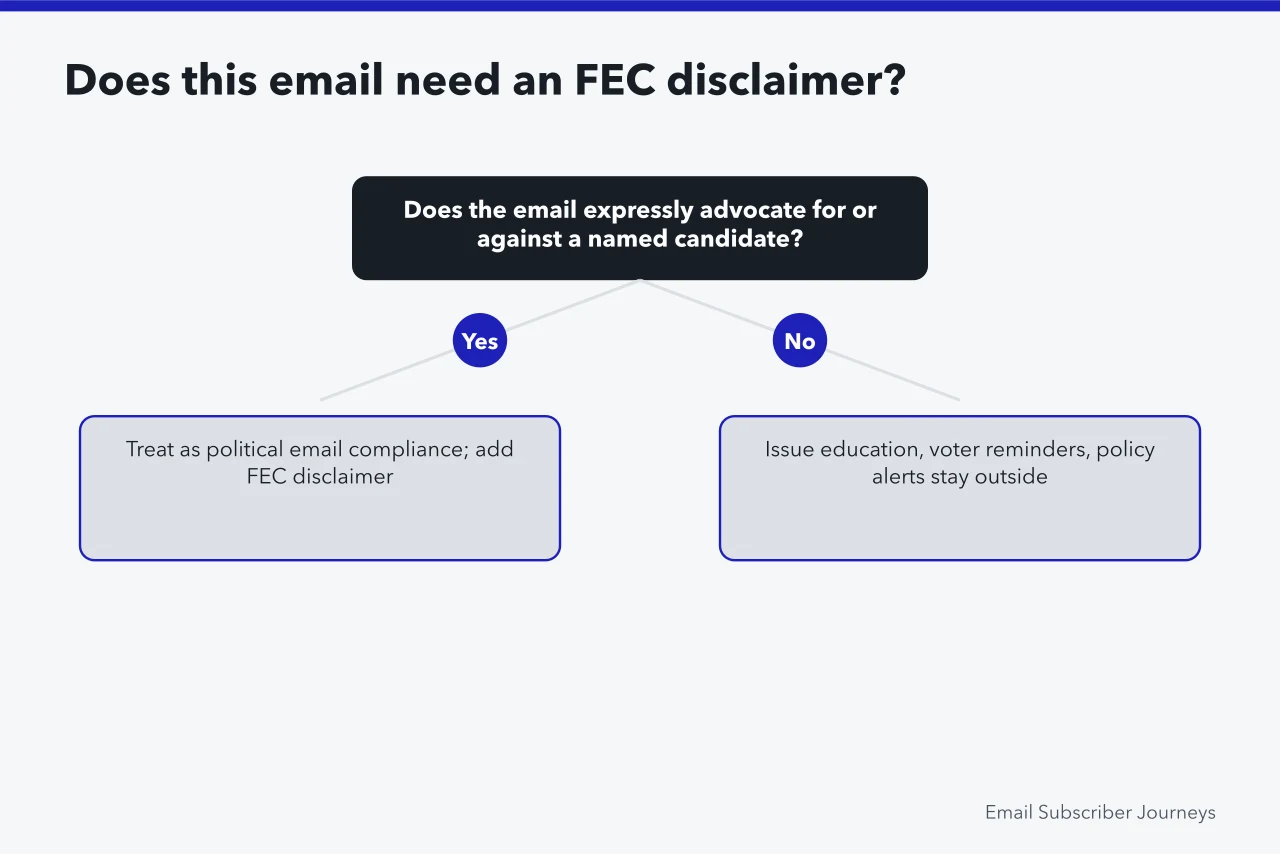
The Federal Election Commission's disclaimer rules implement requirements of the Federal Election Campaign Act for certain political communications. Express advocacy can trigger disclaimer obligations, but not every email that discusses a candidate or party is covered. Whether a particular message requires a disclaimer, and the wording it needs, depends on who paid for it, whether it was authorized, and the type of communication.
Political committees report receipts and expenditures according to FEC schedules. Charitable gifts, by contrast, belong in the nonprofit's accounting and IRS substantiation records. Email teams should coordinate with finance so the data supporting each kind of report can be retrieved.
The FEC publishes filing calendars and form instructions for political committees. Coordinate with the committee treasurer or compliance lead to determine which reporting schedule applies; CRM exports should support those reports rather than assume every subscriber record is reportable.
Issue education, voter registration reminders, and policy alerts are not, by themselves, express advocacy. They may still need review under other FEC disclaimer rules, depending on the organization and communication. When a message asks readers to vote for or against a named candidate, treat it as political compliance work and check whether the applicable disclaimer rules cover the send.
Deliverability matters here too. Campaign and advocacy domains are frequent targets for spam traps and blocks, and a burst of political mail can damage a shared sending domain. Keep political sends on a separate subdomain from your charitable program mail, and keep authentication records current.
To map which messages fall where, build the flow deliberately. The subscriber journey stages that carry advocacy content should be tagged separately from those that carry appeals. That tag then drives both your disclaimer logic and your reporting exports.
IRS substantiation and disclosure rules for nonprofit solicitations
The Internal Revenue Service regulates charitable substantiation, not campaign communications. When a written acknowledgment is required and a donor receives goods or services in return, the charity should describe them and provide a good-faith estimate of their value. Build the acknowledgment process to capture that information accurately.
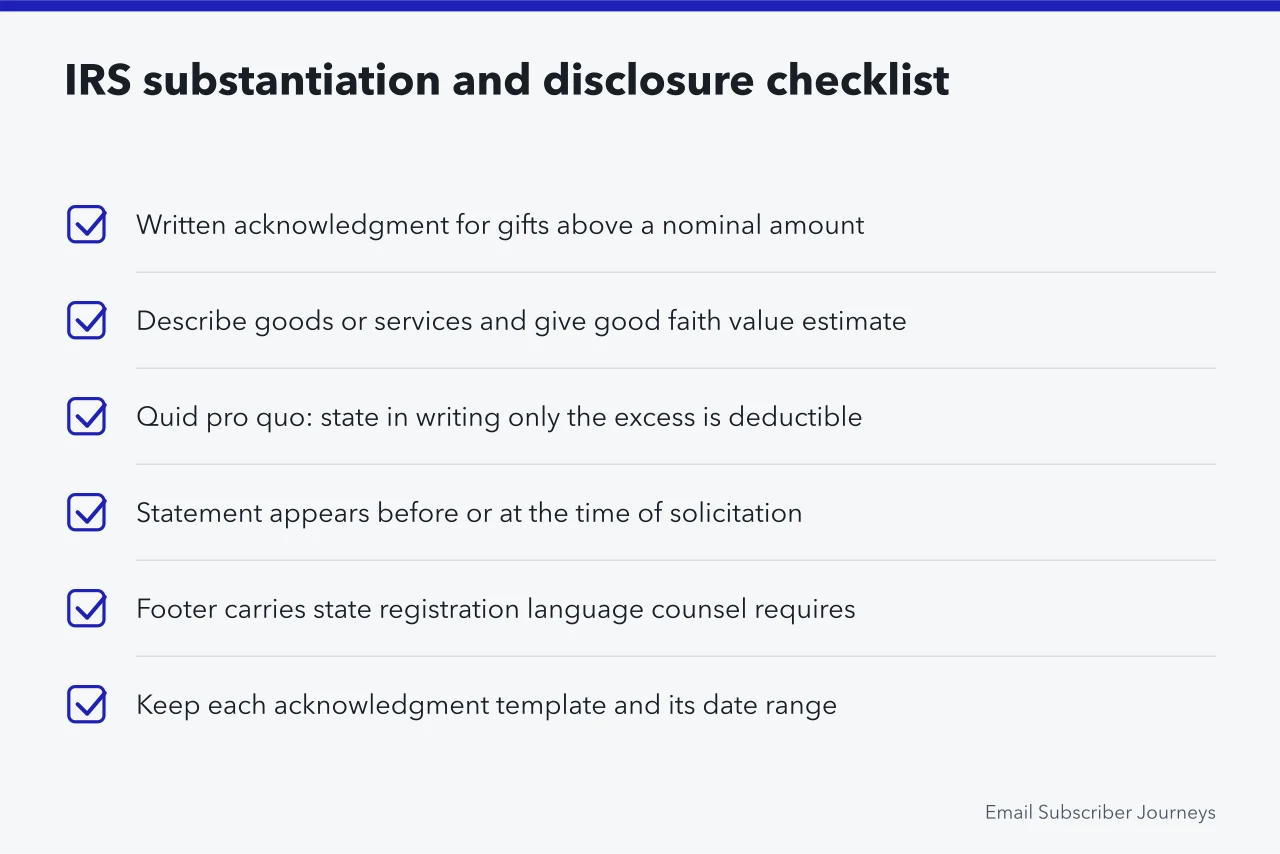
When a quid pro quo contribution meets the IRS disclosure threshold, the organization must tell the donor in writing that only the amount exceeding the value of the goods or services is deductible. The organization should also be able to support its estimate of their value.
That statement usually has to appear before or at the time of solicitation, which puts it squarely inside your donation email.
Nonprofit solicitation disclosure rules also cover state registration, and organizations that solicit nationally often need to register in multiple states. Requirements vary by state; the National Association of State Charity Officials (NASCO) maintains a directory of state charity regulators. Your email footer is the practical place to carry the registration language your counsel requires, because it travels with every send.
Substantiation is a records problem as much as a wording problem. The acknowledgment must be written, and email counts, but you need to be able to show what was sent and when. Keep a copy of every acknowledgment template and the date range it was in use.
The IRS maintains a hub for charities and nonprofits that collects the publication numbers, filing requirements and disclosure guidance organizations rely on. The Charities and nonprofits | Internal Revenue Service page is the starting point for confirming which rules apply to your organization type.
For a fuller treatment of the acknowledgment language itself, see the IRS guidance on Charitable organizations: substantiation and disclosure requirements | Internal Revenue Service. It sets out what the written acknowledgment must contain and when the quid pro quo statement is required.
Designing fundraising journeys that satisfy both regimes
A fundraising journey can start with a policy alert, move to a petition, then ask for money. Each step changes the compliance posture, so the design has to carry the rules rather than bolt them on at the end.
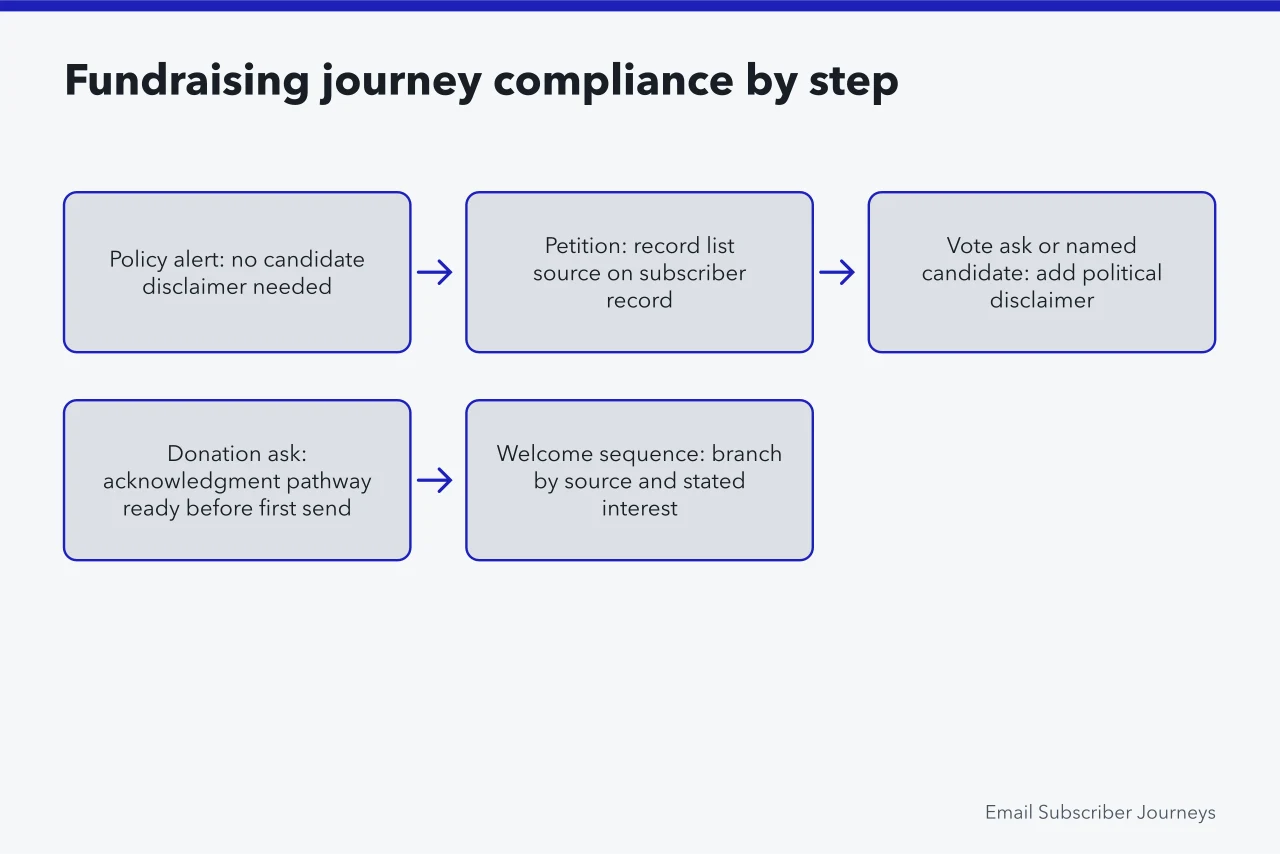
Start by separating list sources. Advocacy signups, event attendees, petition signers and donors should enter through distinct paths, with the source recorded on the subscriber record. That single field lets you decide later which messages need a political disclaimer and which need a charitable solicitation footer.
Then decide what each message is for. A message that only educates does not need a candidate disclaimer. A message that asks for a vote, or that names a candidate and urges support, does. A message that asks for a donation needs the acknowledgment pathway ready before the first send goes out.
A behavioral trigger email journey built on donation page visits should have a clear path: record the visit, check the subscriber's consent and suppression status, then send relevant follow-up content consistent with their preferences. If the person gives, stop donation reminders and route the gift into the correct acknowledgment process. Test the trigger and receipt flow with a small segment before using it broadly.
Your welcome email sequence is where much of the journey is set. Start by routing subscribers according to signup source and stated interest, then deliver the information or action they signed up for. Follow with relevant advocacy or fundraising content through separate branches, and make sure each branch uses the appropriate disclaimer or charitable acknowledgment process.
For US audiences, review the CAN-SPAM Act and Federal Trade Commission (FTC) guidance on determining an email's primary purpose; do not assume every nonprofit advocacy or fundraising message is covered in the same way. For Canadian recipients, use the CASL email subscriber journey rules to check consent, suppression lists, unsubscribe handling, and sender identification. For every audience, test suppression and unsubscribe handling after each template change.
A worked example makes the logic concrete. Suppose an environmental group sends a three-step sequence to a list built from a petition.
- Step one is an issue update with no candidate mention. It carries the standard nonprofit footer and the state registration line.
- Step two names two members of Congress and asks readers to call their offices. It carries the advocacy footer and is not express advocacy for or against a candidate.
- Step three asks for a $50 gift and offers a tote bag valued at $12. It includes a voluntary quid pro quo disclosure, and the acknowledgment email that follows identifies $38 as the contribution portion.
That sequence keeps the purpose and disclosure for each message clear. If step two urged a vote for a named candidate, review whether the FEC disclaimer rules apply to that communication based on the sender, payment, and authorization, and check whether the send counts as a contribution to the campaign.
Keep a small matrix of message type against required footer. Review it regularly, because the rules and your program both move. Use the common email marketing strategy questions as a prompt for that review so it does not get skipped.
Disclaimers and reporting duties in political email
When an FEC disclaimer is required, it must clearly identify who paid for the communication and whether it was authorized. The exact wording depends on the committee and circumstances, so check the FEC's guidance rather than applying one template to every email.
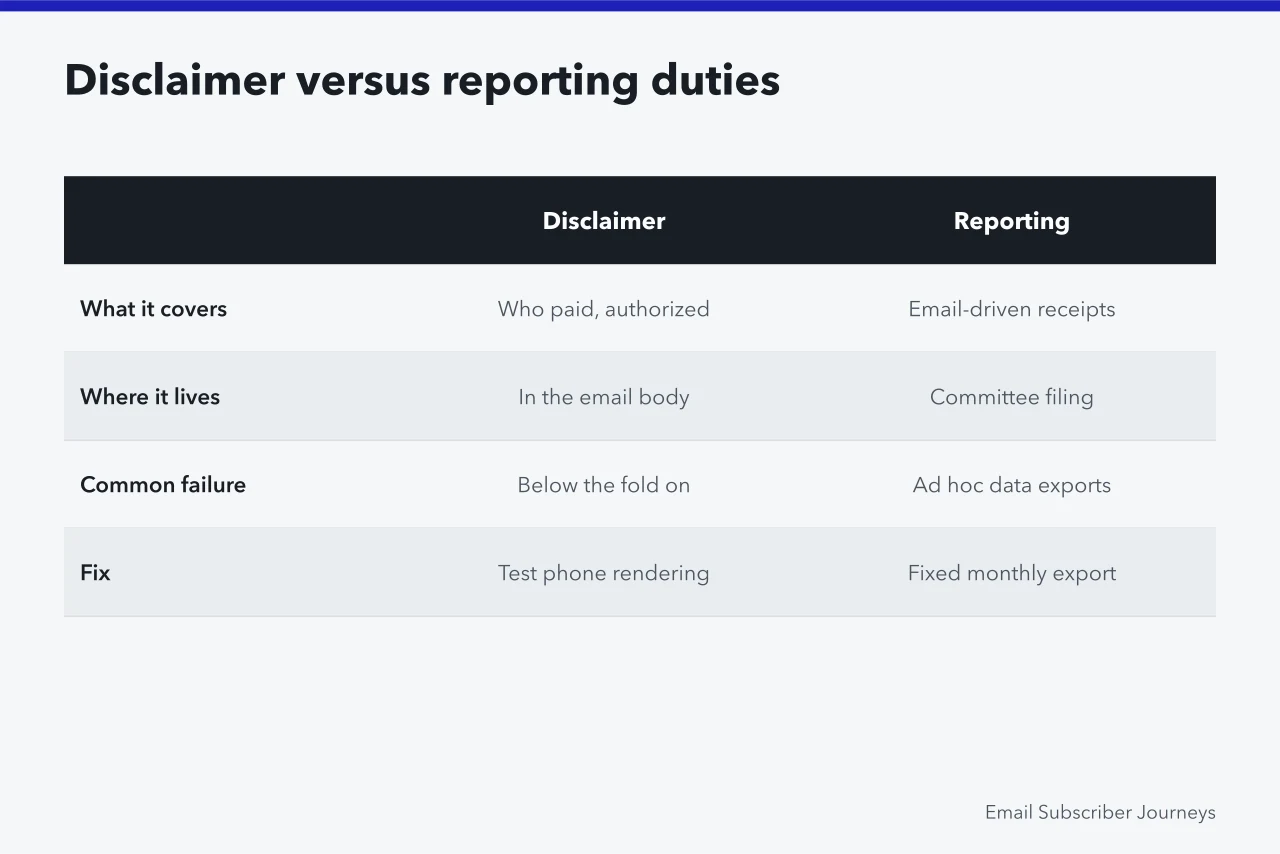
The disclaimer generally has to be conspicuous. In email, that usually means it appears in the body, not buried in a footer image or a linked page. Small text at the bottom of a long message is a common failure point in complaints.
Reporting duties are separate from disclaimers. A committee that raises money through email has to report those receipts on its filing schedule, and the email team is usually the source of the underlying data. The FEC | Filing candidate reports page lays out the reports and the deadlines that drive those exports.
Set an export schedule with your finance or compliance lead that matches the committee's reporting calendar. Store the export with the send log and keep the process consistent, so your team can retrieve the data supporting a report when a question arises.
Disclaimer placement is also a design question. If your template puts the disclaimer below the fold on mobile, it may not be conspicuous. Test the rendering on a phone before you rely on it.
For the exact wording options, the FEC's FEC | Advertising and disclaimers page is the reference to work from. It covers the content of disclaimers and the situations where a shortened form is allowed.
Enforcement and advisory opinions worth knowing
The FEC enforces through complaints, audits and referrals, and it publishes advisory opinions that explain how it reads its own rules. Those opinions are useful because they show how the Commission applies the regulations to real communications, including email.
The regulations themselves are the primary source. The FEC's FEC | Legal | Regulations and Rulemakings page collects the rules that govern contributions, communications and reporting, and it is the place to check before you rely on a summary.
On the IRS side, documentation supports substantiation and filing records. Keep acknowledgment templates, send dates, and the reasoning behind reported amounts so your organization can explain how it handled a gift.
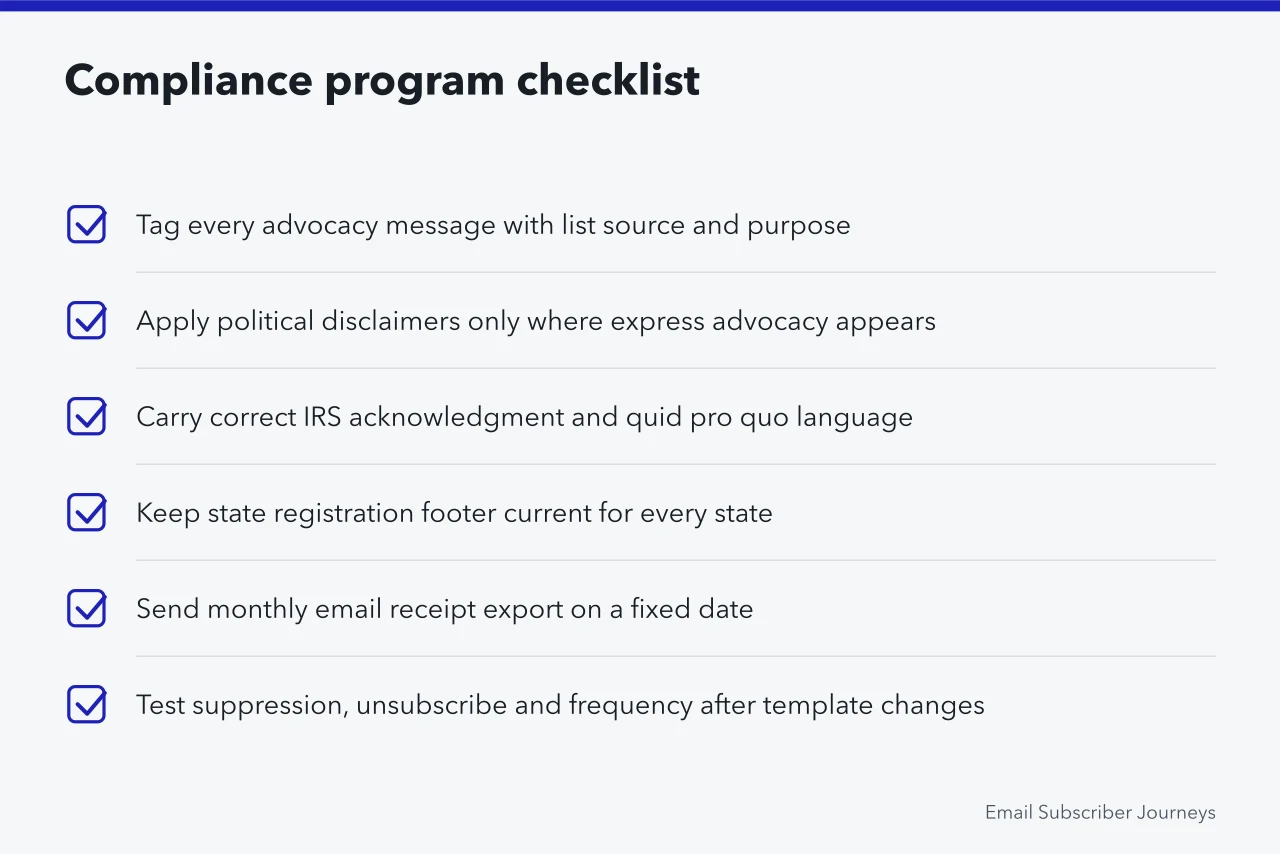
A short checklist keeps the program honest.
- Every advocacy message is tagged with its list source and purpose.
- FEC disclaimer requirements are checked against the communication, sender, payment, and authorization—not just whether it uses express advocacy.
- Fundraising messages follow applicable IRS acknowledgment and quid pro quo disclosure rules.
- The state registration line in the footer is current for every state you solicit.
- Email-driven receipt exports go to the compliance lead on a schedule agreed with finance.
- Suppression, unsubscribe, and frequency rules are tested after every template change.
- A copy of each footer and disclaimer version is archived with its date range.
Re-engagement sends deserve a note here. A re-engagement email journey that asks lapsed donors to give again is still a solicitation. First check the subscriber's status and preferences, then explain why you are reaching out and make a relevant ask. Suppress anyone who has unsubscribed or is otherwise ineligible, and route any new gift through the same acknowledgment process as a first ask.